
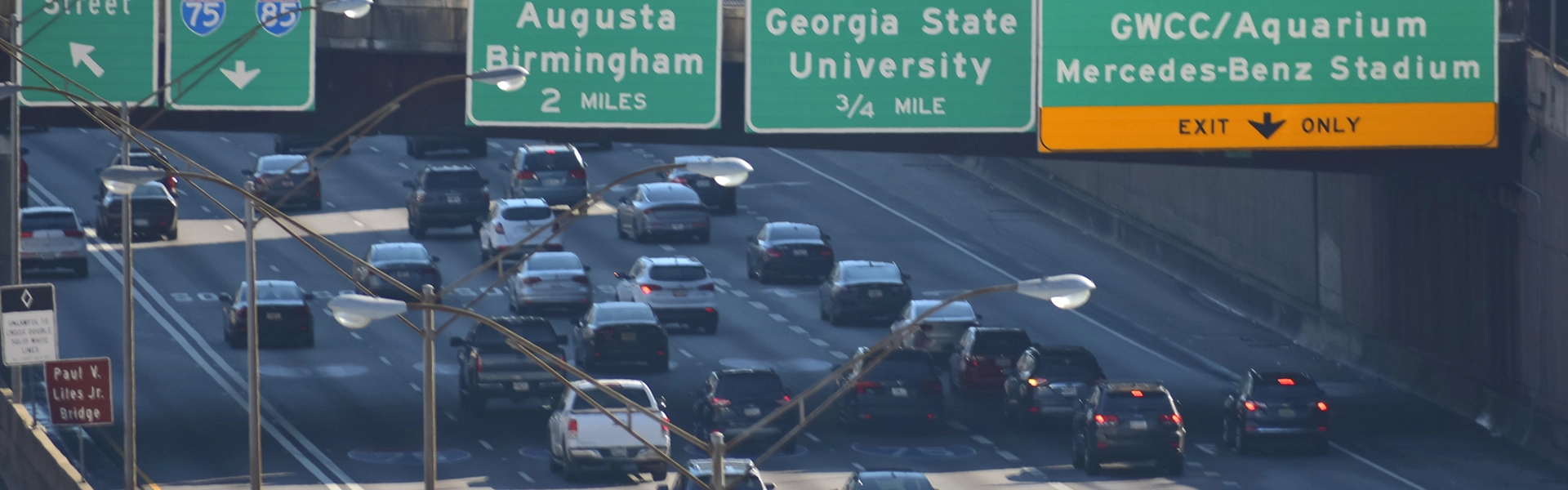
Industry experts say three revolutions are redefining transportation—automation, electrification and shared mobility. Each has the potential to improve traffic congestion, reduce emissions and make travel safer and more accessible. In metro Atlanta, where congestion has long been a challenge, those changes can’t come soon enough. The arrival of the 2026 FIFA World Cup is helping strengthen the region’s transportation network and accelerating the testing of innovations that could permanently improve how residents and visitors get around.
Necessity Drives Invention
Atlanta’s traffic challenges are well known. In 2024, the region ranked 8th worst in the nation for commuting, with average one-way trips stretching 12.8 miles and taking 32 minutes—costing drivers an estimated 65 hours a year in lost time. As the metro area continues to grow, so too will the strain on its roadways.
Yet the same forces that make Atlanta a hub of congestion also make it a hub of innovation. Georgia has become a national leader in electric vehicle (EV) manufacturing, clean technology, autonomous vehicle (AV) research and testing and intelligent transportation systems, supported by companies like Rivian, Hyundai, SK Group and Georgia Institute of Technology.
The goal isn’t simply to move people faster—it’s to move them better. Research by Arthur D. Little finds that despite growing transit options, private cars still account for about 70% of trips in urban areas and 90% in rural regions. This car dependency contributes to more than one-third of U.S. CO₂ emissions, with passenger and commercial vehicles contributing the highest amount of emissions.
But change is underway. A McKinsey Center for Future Mobility survey shows that consumers are open to changing their transportation habits:
- 30% of respondents plan to increase their use of micromobility or shared services
- 46% are open to replacing private cars with other modes in the near future
- 7 in 10 said they would use a shared autonomous shuttle (replacing private vehicle trips)
This ecosystem of talent, infrastructure and investment—combined with the high-stakes pressure of hosting the World Cup—positions Atlanta to become a proving ground for the next generation of mobility.
HOW ATLANTA RANKS
The Urban Mobility Readiness Index, created by the Oliver Wyman Forum and the University of California, Berkeley, ranks 70 global cities on how prepared they are to meet the future of mobility.
ATL ranked #30 globally – a “developing” city
- #16 for technology adoption
- #37 for sustainable mobility
- #42 for public transit
Strengths
High-quality and connected roads with an advanced traffic management system, including coordinated traffic lights and HOV lanes. Also a leader in connected and AV technologies.
Challenges
Despite improvements to cycling and pedestrian infrastructure, Atlanta is still largely car dependent.
Source: Urban Mobility Readiness Index
Revolution 1: Electrification – Georgia Has the Juice
Georgia has emerged as a national leader in the electric vehicle and clean energy sectors with more than $31.3 billion in investments in EVs, batteries and related technologies. These investments include major projects like a $2.5 billion lithium-ion battery plant in Coweta County, Hyundai Motor Group’s $12.6 billion investment near Savannah, Georgia and the Rivian EV factory spanning Morgan and Walton counties.
New research shows that the state has made significant strides in reducing its greenhouse gas emissions while growing the economy, thanks to replacing coal power plants with alternative energy sources. However, its transportation emissions have changed little since 2005. According to the article, Georgia Tech researchers see electrification as part of the path forward, recommending the state continue to expand its EV adoption and electrifying freight fleets. In 2004, Georgia was a national leader in selling over 3,000 non-passenger medium- and heavy-duty electric vehicles.
Together, these developments are positioning metro Atlanta as a key node in the national EV network—powering not only vehicles, but economic growth.
Revolution 2: Automation – The Future Just Pulled Up
Automation promises to make transportation safer, more efficient and ultimately less costly by reducing human error. Some manufacturers have taken the next step and removed the driver altogether. Autonomous vehicles (AVs) can be seen around metro Atlanta, where the robotaxi Waymo was officially rolled out in June. Available exclusively through Uber, riders can enter their preference and boost their chances of getting matched to the AV, which will take them around the city – from Downtown to Buckhead to Capitol View – and the platform has plans to expand in the future. Lyft riders traveling in Midtown and surrounding areas will have the option to participate in an AV pilot program with May Mobility, which features standby operators for safety and passenger comfort. A new player in the market is Zoox, a robotaxi that currently operates in six other cities and is expanding its fleet of test vehicles with human operators to Atlanta.
While the safety benefits of AVs are clear, the congestion impacts are much less so. While some predict that AVs could eventually use connected technology to drive closer together and reduce delays caused by crashes, they also increase total vehicle trips.
For this reason, the World Economic Forum advocates for a shared–use model that integrates AVs with public transportation (PT) to maximize their complementary roles: “AVs offer direct, flexible and responsive service and PT provides high-capacity, space-efficient and scalable solutions.” This strategic approach could boost the success of both systems and prevent them from competing against each other.
Revolution 3: Shared Mobility – Rethinking the Commute
Transit Momentum
Public transit in Atlanta is rebounding, supported by new investments in MARTA and regional partnerships designed to manage World Cup-related demand. Major global events have historically accelerated transit upgrades—as seen in past host cities for the Olympics and World Cup—and Atlanta is poised to do the same. MARTA has announced plans to operate additional trains before and after the games at the Mercedes-Benz Stadium as well as a pre-game shuttle train between Five Points and the newly renamed Sports, Entertainment and Convention (SEC) District station (formerly Georgia World Congress Center station). The transit agency is also rolling out new rail cars, a new bus network, new fare payment system and extensively refreshed stations in advance of the summer World Cup games.
Bus Rapid Transit
With about 300,000 visitors expected for the matches, MARTA announced earlier this month that the City of Atlanta will have its first bus rapid transit (BRT) line ready in April 2026 before the FIFA matches kick off in June. BRT delivers fast and efficient service that includes such things as dedicated lanes, busways, traffic signal priority, off-board fare collection, elevated platforms and enhanced stations—all at a fraction of the cost of hardrail. The Rapid A (Summer Hill) bus line will have dedicated bus lanes along Hank Aaron Drive that connect southeast Atlanta neighborhoods to Downtown Atlanta.
Micromobility on the Move
Demand for e-bikes, scooters and other small-scale options continues to surge. In 2023, Atlanta ranked 5th nationwide for dockless e-scooter rides, with more than 2 million trips, a 30% increase over 2022 and the highest levels since 2019.
Micromobility devices have become an important connection to public transportation. Shared micromobility can improve access to bus stops and train stations (often referred to as “first/last mile” trips), helping more people safely and seamlessly get to their destination. A survey by NABSA found that 70% of bicycle riders and 16% of scooter riders used shared micromobility to connect to transit. Based on a review of dozens of studies, NABSA also concluded that micromobility use increases with the number of new transit stops, further supporting the use of public transportation.
Bikeshare Subscriptions
High upfront costs for e-bikes (around $1,500) have led to a rise in leasing and subscription models. Two companies, Ridepanda and Whizz, recently expanded to Atlanta.
- Ridepanda partners with employers to offer subsidized e-bike and scooter subscriptions—averaging $125/month—complete with helmet, lock, theft insurance and maintenance.
- Whizz focuses on gig workers, offering rent-to-own e-bikes for couriers and delivery riders, with flexible financing and a $139/month subscription.
These options are arriving just in time for Atlanta’s World Cup crowds and growing interest in sustainable commuting.
Pooling Rides
As hybrid work settles in, carpooling and vanpooling are regaining momentum. Georgia Commute Options (GCO) works with employers, property managers and local Transportation Management Associations (TMAs) to connect commuters and reduce drive-alone trips.
A recent success: Perimeter Community Improvement Districts’ Rapid Ride, which links workers in Brookhaven, Dunwoody and Sandy Springs. Groups of 5–8 riders share a van for a flat $75 monthly fee, covering insurance, fuel, maintenance and roadside assistance. Compared to the average monthly cost of owning a car ($1,025), the savings is clear—and the benefits ripple out through reduced congestion and emissions. GCO can help you set up your vanpool program and save money, including on FICA through the federal IRS Qualified Transportation Fringe Benefit.
Read more about our 12 Free Services!
The Way Forward
The mobility revolution isn’t about one technology or company—it’s about how all these systems interconnect. As electrification reduces emissions, automation improves safety and efficiency and shared rides make mobility more affordable and inclusive, metro Atlanta is uniquely positioned to model a smarter future. With its mix of innovation, investment and collaboration, the region is proving that the future of transportation doesn’t just move people—it moves communities forward.
Georgia Commute Options—a program made possible by the Atlanta Regional Commission and Georgia Department of Transportation—works with businesses, property managers, CIDs and local transportation management associations to develop and implement commute programs and services that reduce traffic congestion and improve air quality across the region.